Dubai is often promoted as one property market. In reality, it contains several markets moving at different speeds.
A waterfront apartment in Dubai Marina, a family villa near Emirates Road and an off-plan property in Dubai South may all be located within the same emirate, but they can have very different prices, tenants, supply pipelines, risks and exit strategies.
That is why investors should look beyond attractive towers, payment plans and promotional brochures.
Before buying, ask:
-
Who is likely to live in this location?
-
What supports its current price?
-
How much competing supply is coming?
-
What will ownership cost after purchase?
-
Who is the likely future buyer?
-
How quickly could the property be resold?
-
Does the location suit income, growth, lifestyle or long-term development?
This guide divides Dubai into five broad investment corridors to make those questions easier to understand.
The framework uses Sheikh Zayed Road—E11, Sheikh Mohammed Bin Zayed Road—E311, and Emirates Road—E611 as simple geographical reference points.
These are not official government investment zones, and the price bands are not valuations or guaranteed market quotations. Communities can overlap geographically and financially. Every property must still be assessed using recent comparable transactions, realistic rent, service charges, building quality, supply and exit liquidity.
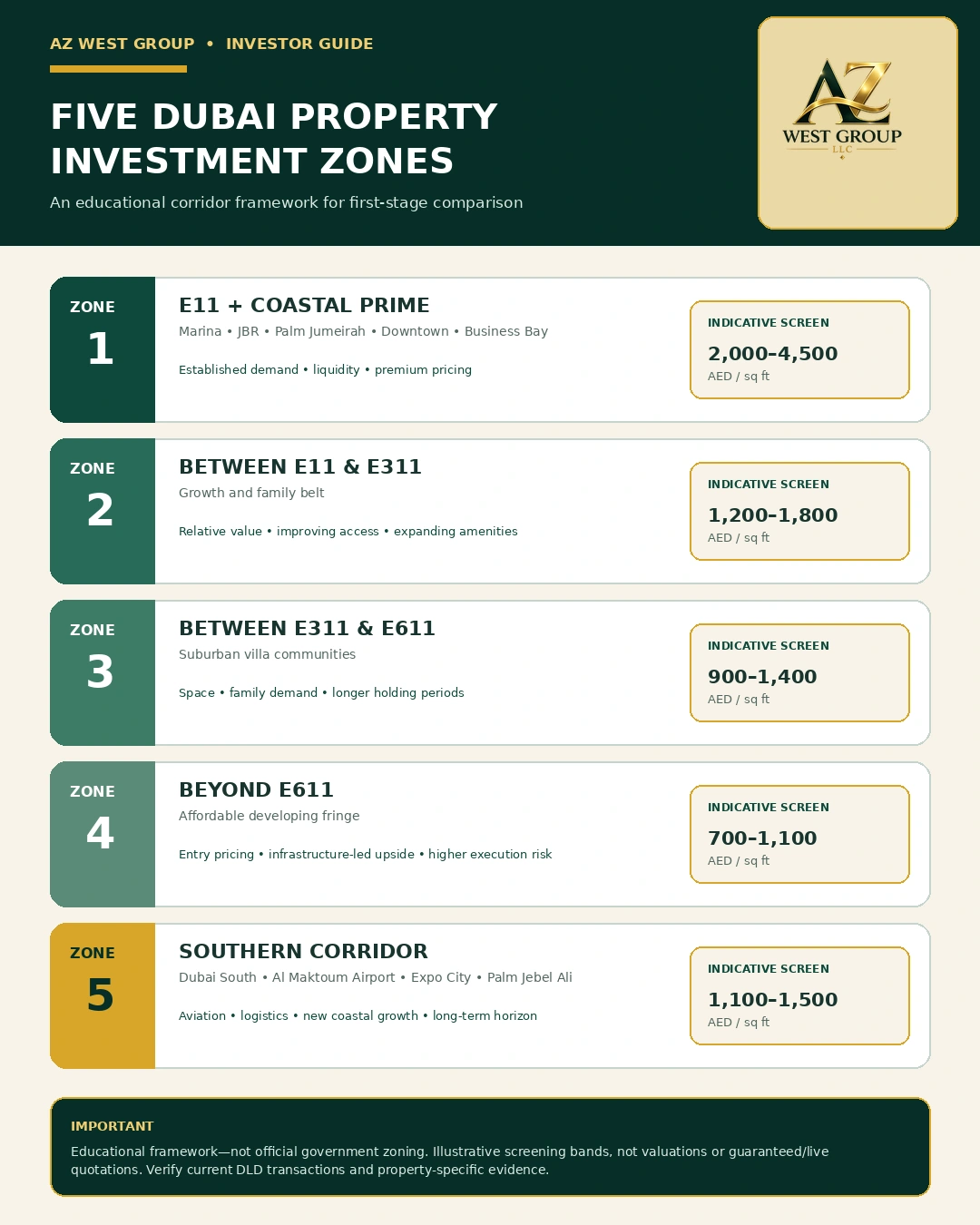
Dubai’s Five Investment Zones at a Glance
| Zone | Broad location | Illustrative price band | General investment character |
|---|---|---|---|
| Zone 1 | E11, coastal and established prime corridor | AED 2,000–4,500 per sq. ft. | Prestige, established demand and stronger international recognition |
| Zone 2 | Between E11 and E311 | AED 1,200–1,800 per sq. ft. | Family demand, accessibility and balanced growth potential |
| Zone 3 | Between E311 and E611 | AED 900–1,400 per sq. ft. | Villa communities, larger homes and longer-term family demand |
| Zone 4 | Beyond E611 | AED 700–1,100 per sq. ft. | Developing locations, affordability and higher infrastructure dependency |
| Zone 5 | Dubai’s southern development corridor | AED 1,100–1,500 per sq. ft. | Airport, Expo City, logistics and long-term southern expansion |
These figures are broad screening bands taken from the original five-zone framework. Actual prices may sit below or above them depending on the property type, developer, project stage, building, view, floor, payment plan and transaction date.
Always verify the specific asset through current Dubai Land Department data and relevant licensed professionals.
Zone 1: E11, Coastal and Established Prime Corridor
Zone 1 covers Dubai’s most internationally recognised locations, including:
-
Dubai Marina
-
Jumeirah Beach Residence
-
Palm Jumeirah
-
Downtown Dubai
-
Business Bay
-
Other established Sheikh Zayed Road and waterfront locations
Why Investors Consider Zone 1
These districts benefit from established infrastructure, recognisable addresses and strong lifestyle positioning.
Demand may come from:
-
International investors
-
High-income professionals
-
Corporate tenants
-
Tourists and holiday-home guests
-
Lifestyle buyers
-
High-net-worth end users
-
Overseas buyers seeking a familiar Dubai address
Dubai Marina and JBR form an established hospitality and leisure centre, while Downtown Dubai and Business Bay form an important commercial and financial corridor. These locations are also identified within the established urban centres of the Dubai 2040 Urban Master Plan.
Potential Advantages
-
Established roads, transport and community facilities
-
Strong international recognition
-
Wider tenant and buyer awareness
-
Access to business, hospitality and lifestyle destinations
-
Potentially stronger resale liquidity for correctly priced assets
-
Existing rental and transaction evidence
-
Limited availability of certain genuinely prime or waterfront positions
Important Risks
A prime location does not make every property a strong investment.
Investors must still examine:
-
High entry prices
-
Building age and maintenance
-
Service charges
-
Traffic and accessibility
-
View protection
-
Upcoming competing developments
-
Holiday-home competition
-
Rental-management expenses
-
Differences between asking and completed prices
Two apartments in the same district can produce very different returns because of the building, layout, floor, view and annual operating expenses.
Who May Find Zone 1 Suitable?
Zone 1 may be relevant for investors prioritising:
-
Established demand
-
International marketability
-
Lifestyle value
-
Prime or waterfront positioning
-
Ready-property income
-
Medium- to long-term capital preservation
It may be less suitable for an investor whose main priority is a low entry price or the highest advertised gross yield.
Zone 2: The E11–E311 Growth and Family Belt
Zone 2 represents the broad area between Sheikh Zayed Road and Sheikh Mohammed Bin Zayed Road.
Depending on the precise project location, the belt can include parts of:
-
Dubai Hills Estate
-
Jumeirah Village Circle
-
Arjan
-
Al Barsha
-
Mohammed Bin Rashid City
-
Other centrally accessible residential communities
These examples should not be treated as one identical market. Each community—and every project inside it—requires separate analysis.
Why Investors Consider Zone 2
This belt can offer a balance between central-city access and more manageable pricing.
Its demand is often supported by:
-
Families
-
Professionals working across different parts of Dubai
-
Residents looking for newer buildings
-
Tenants seeking community facilities
-
Buyers wanting accessibility without paying full waterfront or Downtown premiums
The strongest Zone 2 properties normally combine good road access with schools, retail, parks, healthcare, employment connections and credible community management.
Potential Advantages
-
Lower entry price than many prime districts
-
Access to multiple employment centres
-
Growing family and professional demand
-
Newer buildings and master communities
-
Potential balance between rental income and capital growth
-
Broader selection of apartments, townhouses and villas
Important Risks
The greatest risk is assuming that every new community will perform equally.
Review:
-
Existing and future supply
-
Traffic at peak hours
-
Public transport availability
-
School and retail completion
-
Community service charges
-
Construction around the property
-
Quality differences between developers
-
Number of similar units competing for tenants
-
Actual resale activity—not only developer launch prices
A lower price per square foot can be attractive, but only when the property also has sustainable demand and a realistic exit market.
Who May Find Zone 2 Suitable?
This corridor may suit investors seeking:
-
A balance between price and location
-
Family-led tenant demand
-
Mid-market rental income
-
Newer residential stock
-
A medium- or long-term holding strategy
Zone 3: The E311–E611 Suburban Villa Belt
Zone 3 broadly covers communities between Sheikh Mohammed Bin Zayed Road and Emirates Road.
It is commonly associated with:
-
Larger family-oriented developments
-
Villa and townhouse communities
-
Lower-density neighbourhoods
-
Properties offering more internal and outdoor space
-
Residents who accept longer journeys in exchange for lifestyle and space
Depending on their precise position, communities in and around this wider belt may include Arabian Ranches, Mudon, DAMAC Hills, Villanova, Town Square and similar family-led districts.
Why Investors Consider Zone 3
Demand for villas and townhouses is usually linked to genuine family requirements rather than only short-term investor activity.
Tenants and buyers may prioritise:
-
Larger homes
-
Gardens and outdoor space
-
Schools
-
Parks
-
Community retail
-
Privacy
-
Long-term occupancy
-
A quieter environment
This can create a different demand profile from small, investor-heavy apartment buildings.
Potential Advantages
-
Larger properties for the investment amount
-
Family-oriented demand
-
Potentially longer tenant retention
-
Community lifestyle
-
Lower-density development
-
Greater variety of villas and townhouses
-
Possible long-term value from community maturity
Important Risks
Investors should test:
-
Road and transport dependency
-
Distance from employment centres
-
School and community completion
-
Landscaping and facilities
-
Maintenance responsibilities
-
Villa repair and cooling costs
-
Future phases adding competing supply
-
Differences between built-up area and plot size
-
Handover quality
-
Service and community-management charges
Villa demand can be resilient, but the wrong entry price or an oversupplied layout can still weaken the investment.
Who May Find Zone 3 Suitable?
Zone 3 may be relevant for investors targeting:
-
Families
-
Villas and townhouses
-
Longer tenancies
-
Larger living space
-
Community-led demand
-
A longer holding period
Zone 4: Beyond E611 and the Developing Fringe
Zone 4 covers developing locations beyond Emirates Road and other outer growth areas.
These locations may offer lower advertised prices, larger plots or early access to new communities. Their success, however, can depend heavily on future roads, services, population growth and developer execution.
Why Investors Consider Zone 4
The principal attraction is affordability and the possibility of entering before the location becomes fully established.
Investors may be attracted by:
-
Lower starting prices
-
Larger property sizes
-
Long payment plans
-
Early-development positioning
-
Future infrastructure plans
-
Potential community growth
Potential Advantages
-
Lower capital entry
-
Greater space for the budget
-
Longer-term development potential
-
Access to early project phases
-
Possibility of benefiting as facilities and population increase
Important Risks
This is where investors must separate a future vision from current reality.
Verify:
-
Which roads are approved, funded or under construction
-
Whether schools, retail and healthcare are operational
-
Actual construction progress
-
Developer delivery history
-
Project escrow information
-
Distance from current employment centres
-
Realistic tenant demand after handover
-
Number of competing units
-
Resale restrictions
-
Whether the buyer can hold the property if growth takes longer than expected
A future road, shopping centre or transport connection should not be treated as completed until its official status and delivery timetable are verified.
Who May Find Zone 4 Suitable?
Zone 4 may suit investors who:
-
Have a long investment horizon
-
Can tolerate slower community development
-
Are not dependent on immediate rental income
-
Understand construction and infrastructure risk
-
Maintain sufficient liquidity
-
Can hold through changing market conditions
It is generally less suitable for buyers needing immediate resale liquidity or stable, proven rent from the first day.
Zone 5: Dubai’s Southern Growth Corridor
Zone 5 covers Dubai’s major southern development direction, including:
-
Dubai South
-
Expo City Dubai
-
Al Maktoum International Airport corridor
-
Residential districts around the airport and logistics ecosystem
-
Palm Jebel Ali’s wider influence area
This corridor combines residential, aviation, logistics, exhibitions, tourism, employment and long-term infrastructure themes.
Why Investors Consider Zone 5
The Dubai 2040 Urban Master Plan identifies Expo City as an economic and growth centre connected with exhibitions, tourism, logistics and housing.
Al Maktoum International Airport is also undergoing a major expansion. Its long-term design capacity is planned at up to 260 million passengers annually, while current government planning places the commencement of operations under the expanded programme in 2032.
These developments can support long-term demand, but infrastructure investment does not automatically guarantee property appreciation.
Potential Advantages
-
Major government-supported infrastructure
-
Airport and logistics-related employment
-
Expo City growth
-
New residential and commercial communities
-
Potential long-term population movement
-
A mix of affordable and premium future supply
-
Strategic importance within Dubai’s wider expansion
Important Risks
Investors should examine:
-
The time required for the area to mature
-
Distance from existing central districts
-
Construction and handover schedules
-
Volume of planned supply
-
Dependence on future population and employment
-
Whether infrastructure expectations are already included in the asking price
-
Differences between Dubai South projects
-
Rental demand at the expected handover date
-
Resale liquidity before community maturity
Do not purchase only because a property is described as “near the airport.” Confirm the exact travel distance, road access, project location and realistic benefit to the eventual resident or tenant.
Who May Find Zone 5 Suitable?
Zone 5 may suit investors seeking:
-
Long-term urban growth
-
Exposure to aviation and logistics expansion
-
Dubai South or Expo City opportunities
-
A medium- to long-term holding strategy
-
Entry before full community maturity
Which Dubai Investment Zone Is Best?
There is no single best zone for every investor.
The correct zone depends on the objective.
| Investor objective | Areas of focus |
|---|---|
| Established rental evidence | Zone 1 and mature parts of Zone 2 |
| International recognition and lifestyle | Zone 1 |
| Balanced price and family demand | Zone 2 |
| Villas, townhouses and longer tenancies | Zone 3 |
| Lower entry and long-term development | Zone 4 |
| Airport, Expo City and southern expansion | Zone 5 |
This table is only an initial guide. A strong property in one zone can outperform a weak property in another.
The decision must eventually move from:
Dubai → Zone → Community → Project → Building → Individual property
The closer the investor moves to the individual asset, the more important property-specific evidence becomes.
Price Per Square Foot Is Only the First Comparison
Investors frequently compare properties using price per square foot. This can help, but it can also mislead.
A lower figure may reflect:
-
A weaker building
-
Less efficient layout
-
Higher service charges
-
A lower-quality view
-
Oversupply
-
Limited transport
-
A distant handover
-
Lower resale liquidity
A higher figure may include:
-
Waterfront position
-
Scarcity
-
Better building management
-
Stronger tenant demand
-
Established infrastructure
-
A premium view
-
A recognised developer
-
Furnishing or branded-residence value
Before comparing prices, confirm whether the quoted size refers to:
-
Saleable area
-
Built-up area
-
Internal area
-
Balcony and terrace space
-
Plot size
-
Common-area allocation
Always compare like with like.
How to Compare Properties Across the Five Zones
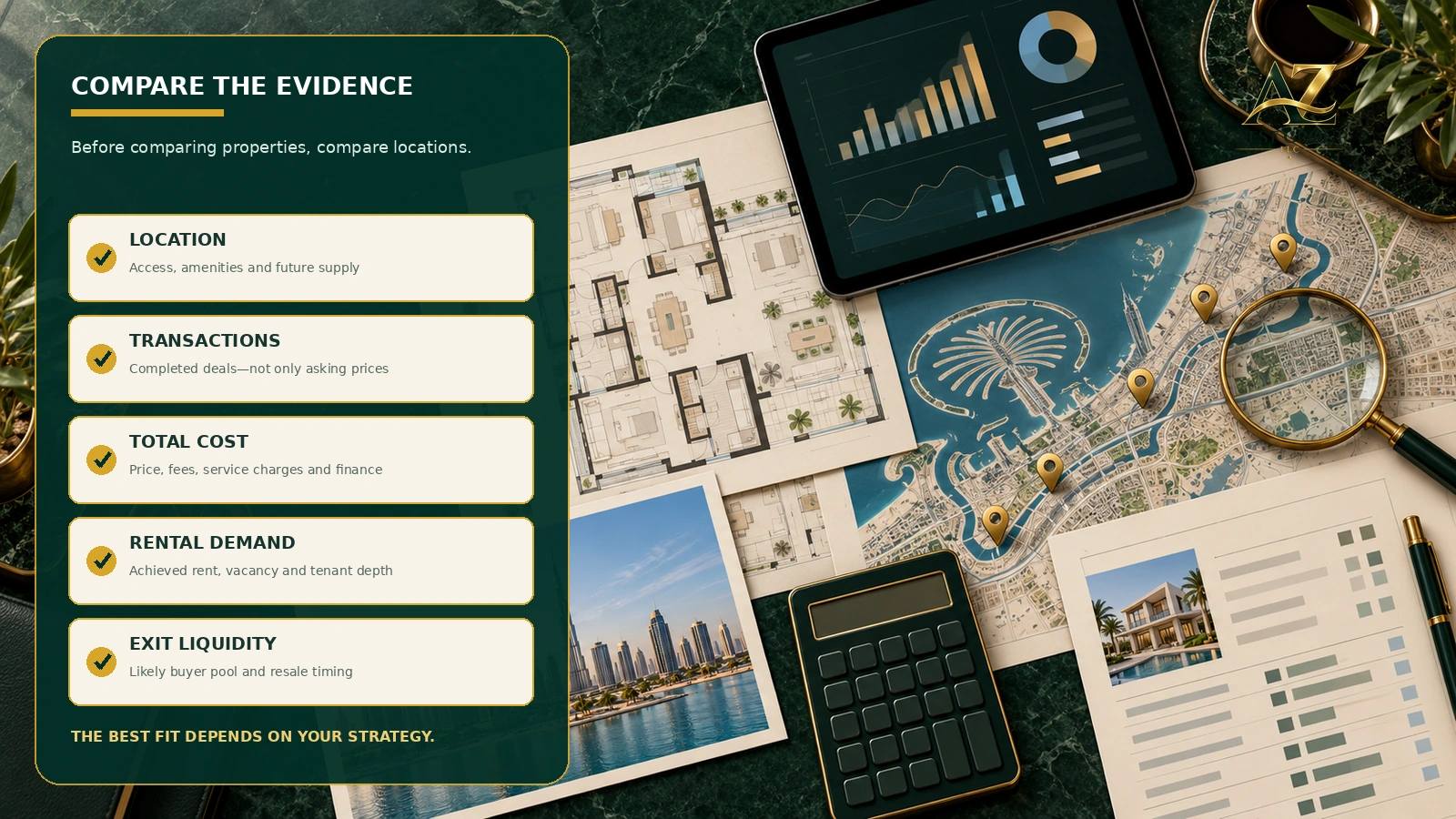
Use the same framework for every opportunity.
1. Investment Objective
Decide whether the priority is:
-
Rental income
-
Capital appreciation
-
Lifestyle use
-
Family residence
-
Portfolio diversification
-
Short-term resale
-
Long-term land or location growth
2. Total Acquisition Cost
Include:
-
Purchase price
-
DLD and registration charges
-
Trustee and administrative fees
-
Agency charges where applicable
-
Mortgage-related costs
-
Legal or valuation expenses
-
Furnishing
-
Utility activation
-
Initial maintenance
Read AZ West Group’s Complete Cost of Buying Property in Dubai before comparing the final capital requirement.
3. Realistic Rental Income
Use registered and relevant rents—not only the highest portal advertisement.
Compare:
-
Same building
-
Similar size
-
Same bedroom type
-
Furnishing
-
Floor and view
-
Number of cheques
-
Current vacancy
-
Competing supply
Then calculate the return after service charges, vacancy, maintenance and management.
Use our guide: Gross vs Net Rental Yield in Dubai.
4. Supply and Competition
Identify:
-
Units already available
-
Projects under construction
-
Expected handovers
-
Similar layouts
-
Future project phases
-
Short-term rental competition
-
Alternative communities at the same price
5. Developer and Project Verification
For off-plan property, verify:
-
Developer registration
-
Project registration
-
Escrow details
-
Construction progress
-
Payment schedule
-
Expected completion
-
Assignment and resale terms
-
Previous delivery history
Dubai REST provides property owners and investors with access to market indicators, project information, completion progress, escrow information, service charges and registered professional details.
6. Exit Liquidity
Ask:
-
Who is the future buyer?
-
How many similar units will compete?
-
Can an end user afford it?
-
Can another investor achieve a realistic return?
-
Is the building attractive after several years?
-
What will make this property different at resale?
A good entry price without a realistic exit plan can still become a difficult investment.
Common Mistakes When Choosing a Dubai Location
Avoid these mistakes:
-
Buying an area only because it is described as “the next hotspot”
-
Treating a future infrastructure announcement as a guaranteed return
-
Comparing asking prices instead of completed transactions
-
Ignoring service charges and recurring costs
-
Using citywide rental averages for one building
-
Assuming every property near a landmark will benefit equally
-
Purchasing off-plan without checking future supply
-
Relying on a quick resale to meet future payments
-
Choosing a payment plan before evaluating the property
-
Treating Dubai as one uniform market
Final Investor Checklist
Before choosing a zone or property, confirm:
-
My investment objective is clear
-
The total budget includes every acquisition cost
-
The price is supported by relevant transactions
-
The rental assumption is realistic
-
Net yield has been calculated
-
Service charges are verified
-
Current and future supply has been reviewed
-
The project and developer are registered
-
Infrastructure status is confirmed
-
The payment schedule is affordable
-
The holding period matches the location
-
A realistic exit buyer has been identified
-
Legal, financial and technical advice has been obtained where required
The AZ West Group View
Dubai’s future will not be created by one road, one tower or one headline.
It will be shaped by multiple urban centres, infrastructure corridors, employment districts, lifestyle destinations and family communities—each developing at a different pace.
Zone 1 may offer established demand and global recognition.
Zone 2 may provide a balance between access, price and family demand.
Zone 3 may support longer-term villa and townhouse strategies.
Zone 4 may offer affordability with greater development risk.
Zone 5 may provide exposure to Dubai’s southern expansion and aviation-led future.
The best investment is not automatically the cheapest property or the most famous location.
It is the property where the price, demand, costs, risks, holding period and exit strategy work together.
Request Your Dubai Investor Strategy Brief
AZ West Group LLC helps local and international investors understand Dubai real estate, compare relevant opportunities and connect with trusted licensed market professionals through clear intelligence and long-term support.
Our process can help you:
-
Define your investment objective
-
Compare suitable locations and property types
-
Review pricing and rental evidence
-
Understand acquisition and ownership costs
-
Identify important risks
-
Create a focused opportunity shortlist
-
Coordinate with appropriately licensed professionals where required
Visit AZ West Group Services or contact us to begin your structured Dubai property comparison.
Frequently Asked Questions
Are these five investment zones official Dubai government zones?
No. They are an educational investor-analysis framework using E11, E311, E611 and Dubai’s southern corridor as geographical references. Official planning and property information should be checked through government sources.
Which Dubai property zone offers the highest rental yield?
No zone automatically provides the highest net yield. Returns depend on the purchase price, achievable rent, occupancy, service charges, maintenance, management expenses and building quality.
Is Zone 1 always the safest investment?
No. Zone 1 benefits from established demand and international recognition, but investors can still overpay or choose a building with high expenses, weak maintenance or excessive competition.
Is property beyond E611 too risky?
Not automatically. Developing locations may offer lower entry prices and long-term potential, but they normally require more patience, liquidity and infrastructure verification.
Is Dubai South a good long-term investment area?
Dubai South has important long-term infrastructure and employment drivers, including Al Maktoum International Airport and proximity to Expo City. Suitability still depends on the specific project, entry price, supply, developer and holding period.
How should I verify Dubai property prices?
Use recent comparable transactions from Dubai Land Department data, review the specific building or project and obtain professional valuation support where necessary. Do not rely only on listing prices or promotional material.
Investor Disclaimer
This article is provided for general education and real estate market-intelligence purposes only. The five-zone model and price bands are broad analytical references—not official zoning, valuations or guaranteed market quotations.
AZ West Group LLC does not guarantee rental income, occupancy, appreciation, resale timing, infrastructure delivery or project performance. Property information, availability, fees, prices and market conditions can change.
Investors should independently verify all information through Dubai Land Department and other official sources and obtain advice from appropriately licensed real estate, legal, tax, mortgage, valuation and technical professionals before making a commitment.